
Share On:
uk vs. uae - Which Is the Best to Invest in Property?
With a lot happening both in the Gulf and in the UK, we’ve been fielding a number of enquiries from clients and prospective buyers pondering whether it is better to buy property in the UAE or in the UK.
Our answer?
It depends.
It depends on your personal circumstances: your timeframes, the aim and context of your investment – whether it is to fund something specific like education or retirement – your appetite for risk and, and, and…There are lots of factors to consider. The comparison isn’t a straightforward one, a little like comparing apples to oranges, or as per another British aphorism, it’s six of one and half a dozen of the other. Nonetheless, with recent global events in mind, it is a question that warrants investigation and so in this month’s market update, we’re going to unpick the comparison and present a useful guide to help you assess two of the most popular residential investment property markets in the world: the UAE and the UK.
Let’s start with cycles…
The London market has historically had a price cycle of 15-18 years; typically involving a phase of intense price growth in which London prices significantly outpace the wider UK average before experiencing a cooling off phase where regional markets catch up. We’ve witnessed this phenomenon in the rise in values of property in Birmingham and Manchester over the last six years and we’re seeing it currently in Liverpool.
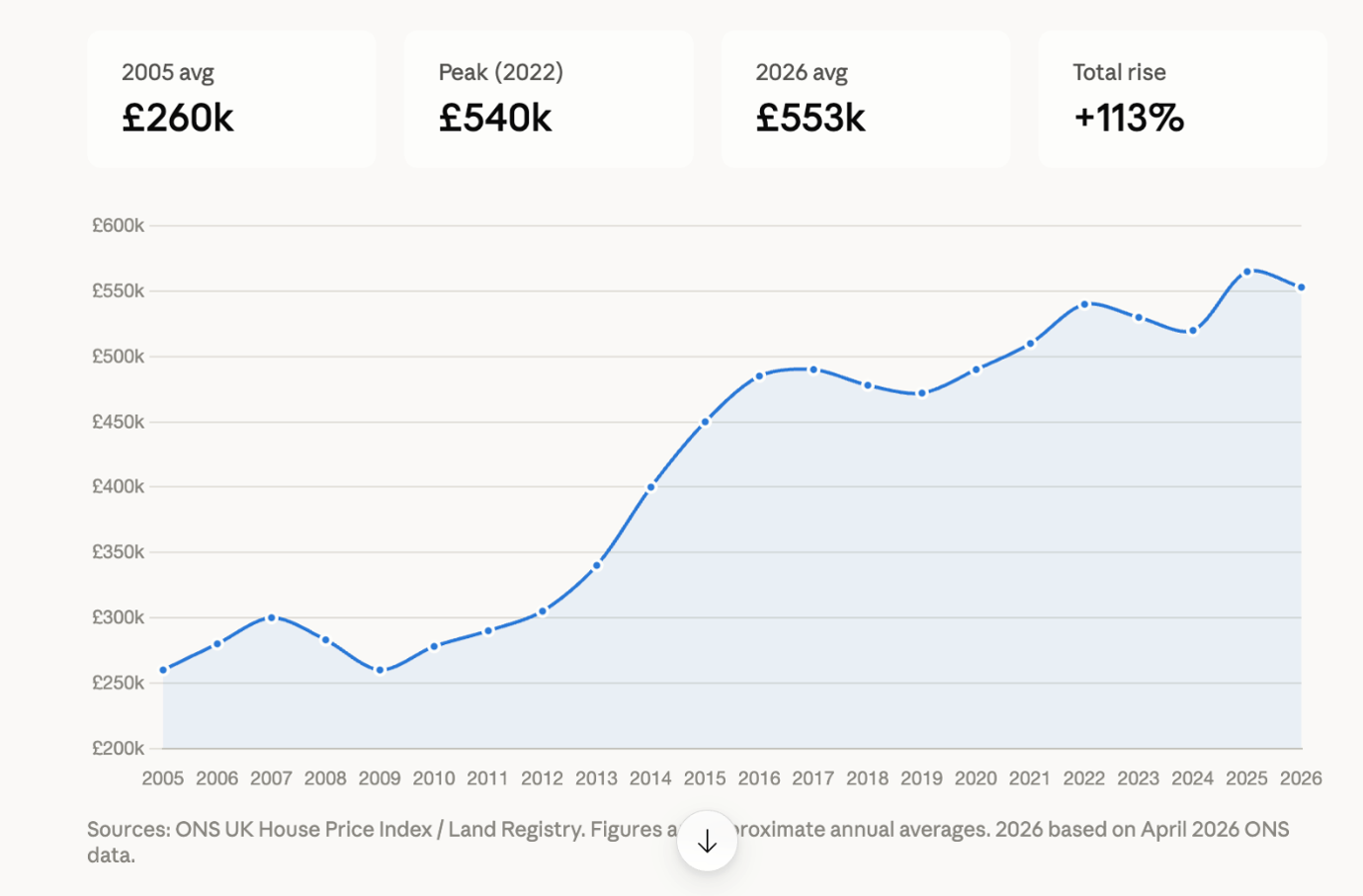
Concentrating on London, looking at the graph below (plotted with data from the ONS) we can see that prices in London peaked in 2007 (Financial crisis/US subprime mortgages), 2016 (Brexit), 2022 (Covid) and in 2025 (global volatility and higher interest rates). What’s interesting to note that the periods of correction in the market are relatively brief. Overwhelmingly, the market shows a steady appreciation over time.
Property price rises in London 2005-2026
In contrast, both the Dubai and Abu Dhabi markets were hit harder by the 2008 global financial crisis; in some cases prices halved overnight and took nearly 15 years to reach the same peak. But, there’s no denying their ascendancy since 2021 has completely outperformed any growth witnessed in London over the same time.

Property price rises in Dubai 2005-2026
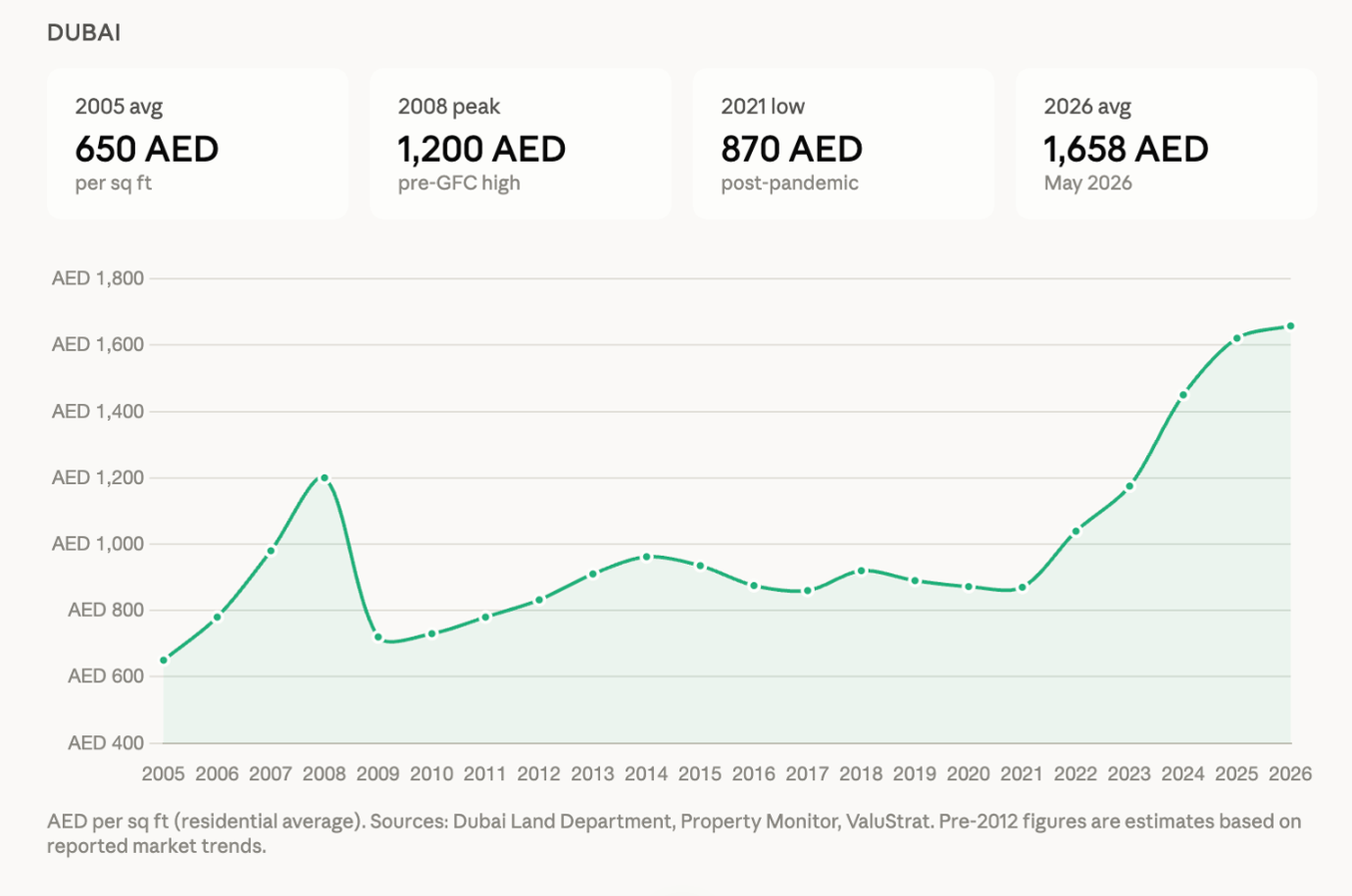
Up until this year, we hadn’t witnessed anything like Dubai’s stunning five-year growth; its “longest ever bull run” according to the Financial Times with 57 straight monthly increases. It was a market unpinned by rapid development and high liquidity, rewarding investors who capitalized on off-plan purchases in master communities to make speculative gains. Flipping returned with gusto.
But, adhering to the laws of gravity, what goes up must come down (or at the very least slow) and Dubai’s incredible capital growth came to an end with the conflict in Iran where, according to al Jazeera, property sales plummeted by a fifth, plunging Dubai immediately into a bear market with a cautious ‘wait and watch’ sentiment emerging amongst investors. Of course, no one could have predicted such a shock, a shock which has been felt most in the emirate’s off-plan market. Much less has been written about Dubai’s villa market which held up remarkably well and still does provide an outlet for those investors looking for a short-term gain.
Recovery is likely in Dubai’s off-plan market, but it remains to be seen just how long the recovery will take to get back to its peak. For those who bought property in Dubai chasing short-term returns, they may find themselves locked into a longer game to realise a profit. Further evidence, that if you base your investment strategy on ‘timing the market’ you do so at your own peril. It’s worth noting the jitters in the market before the conflict sparked, surrounding concerns about a glut of properties and Dubai heading for a correction. The situation with Iran may have fast forwarded the situation, but as ever, there are those willing to clean up in a crisis, swooping in to buy land and developments en masse at a massively discounted rate.
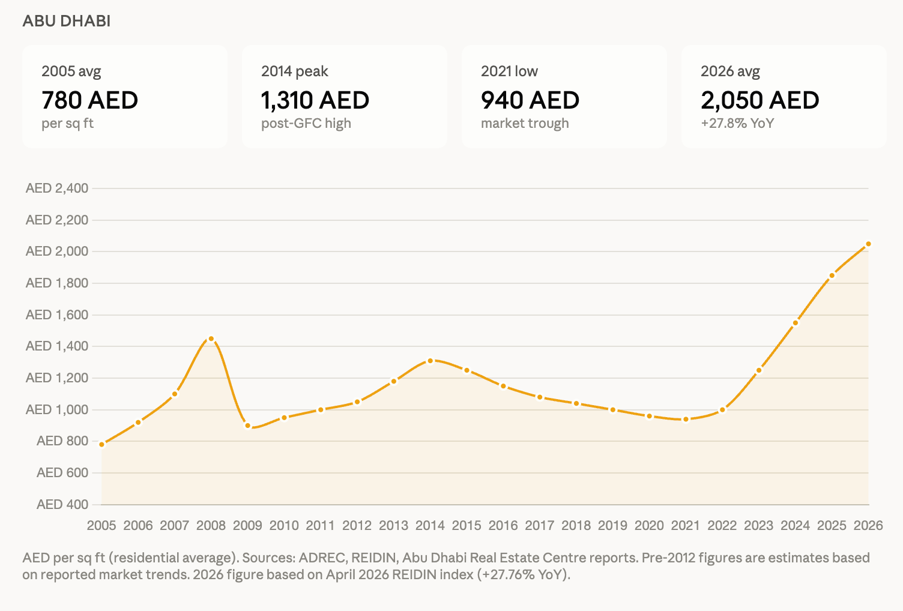
Abu Dhabi, on the other hand, has fared 2026 comparatively much better. Backed by sovereign wealth funds and oil revenue and less reliant on foreign capital and investment, it has somewhat of an economic cushion. The emirate’s residential price index was still showing 27.8% annual growth in April 2026 (compared to Dubai’s 6.90%).
Looking at its cycle, the graph below shows a gentle decline in Abu Dhabi between 2014 and 2021, partly due to lower oil prices and a sustained oversupply of apartments. Traditionally, analysts have pegged Abu Dhabi’s market cycle between five to seven years, however, that appears to be changing now with the Abu Dhabi government following a highly controlled fundamentally driven cycle, cautiously expanding the number of properties on the market with a close eye on end-user demand to avoid the likes of oversupply which we’ve witnessed in Dubai. Let’s not forget, Abu Dhabi has had the learning curve of watching and learning from the Dubai market. The capital of the Emirates only introduced freehold property for purchase by non-nationals in 2019.
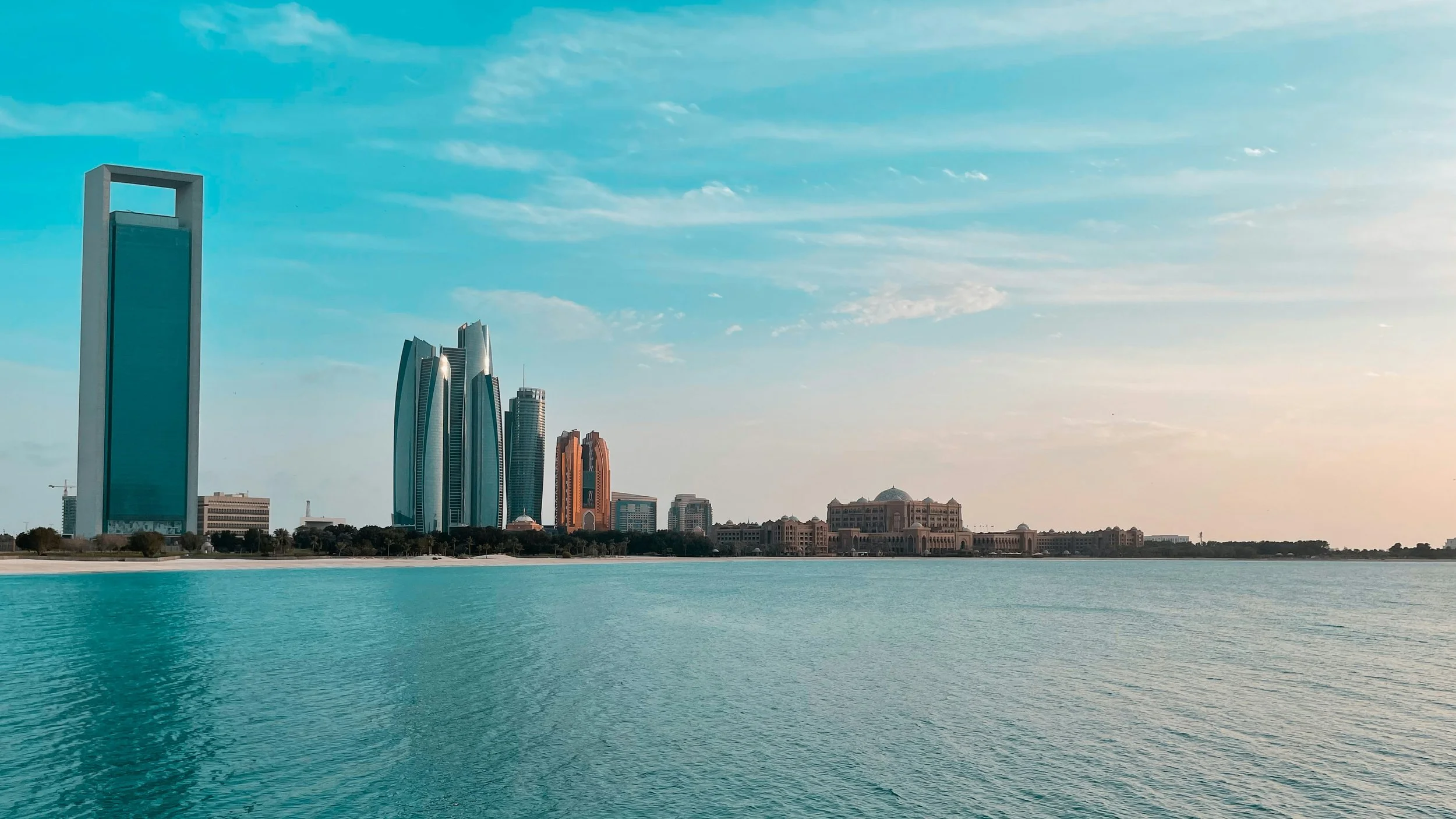
Property price rises in Abu Dhabi 2005-2026
Much like London, Abu Dhabi appeals to risk-averse income focused investors, though the recent frenzy of sold-out launches this year may be doing much to undermine this reputation. That said, Abu Dhabi’s strategy to pioneer ‘master-developed’ neighbourhoods in the city, endowing a tighter structure to its communities and better control of the flow of properties within them, keeps a close control on its pipeline. Abu Dhabi only has 32,000 freehold units coming online in the next seven years, compared with Dubai’s 350k due to complete in the same period.
Effectively, Abu Dhabi is producing its own scarcity of supply to expat investors; hence, the sellout launches at higher retail prices than Dubai. But it’s important to consider that Abu Dhabi is nursing a whole other market; 317,000 non-freehold units that are not for sale to expats. Viewed solely in terms of completed freehold units, Dubai has 600,000 to Abu Dhabi’s 84,000. Yes, the population varies between the two cities - Dubai home to 4 million people versus 2.9 million in the immediate Abu Dhabi city area, that stat highlights perfectly the juxtaposition of the two emirates and their wildly different markets: The strict control of supply in Abu Dhabi versus the construction free for all in Dubai. Still, we’d be cautious looking at the numbers and the glut of properties Dubai faces, notwithstanding its target to attract 7.8million residents by 2040.
What’s clear and undisputed from all three graphs, is the commodification of residential property since 2005 across the three global markets.
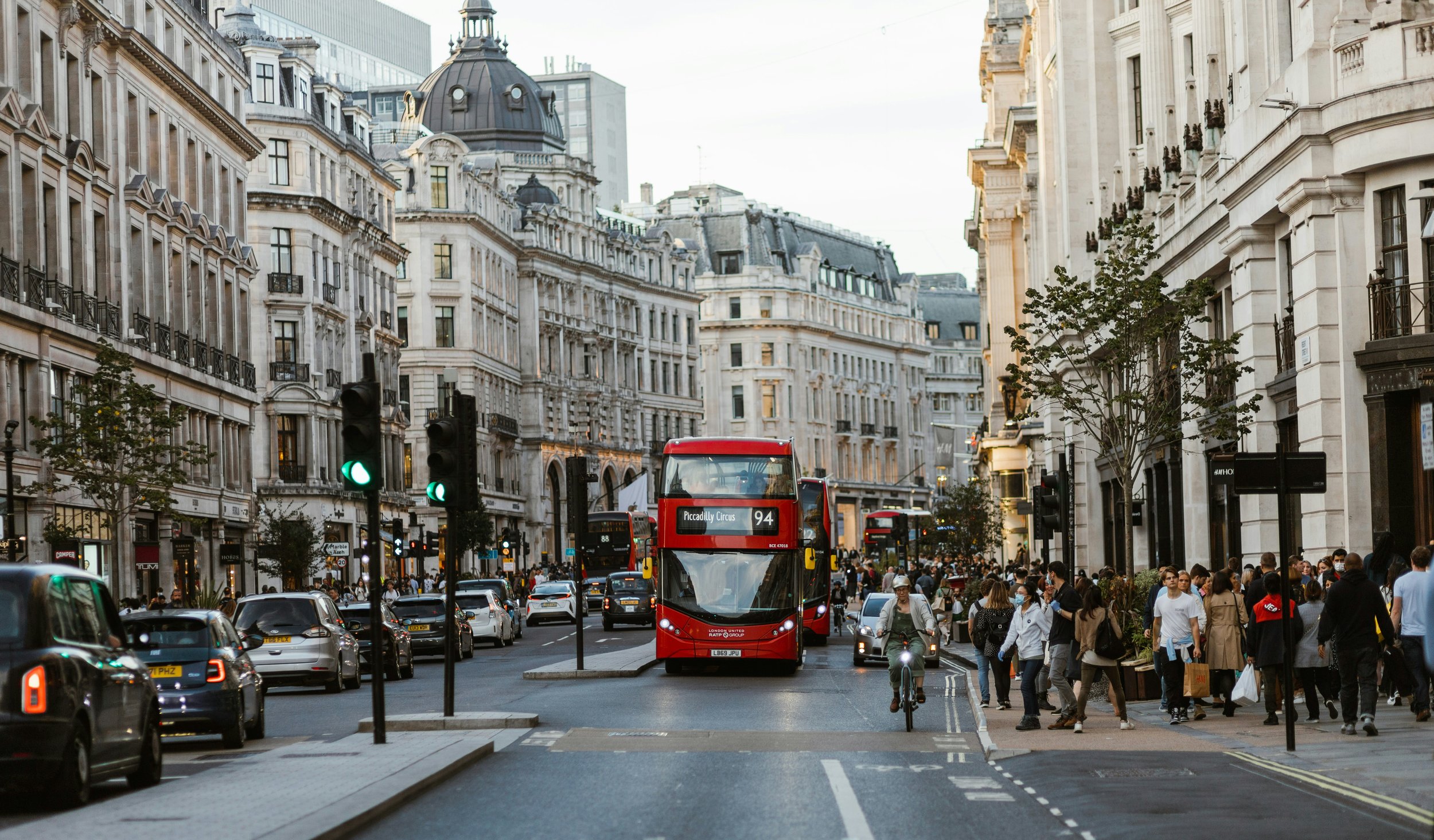
London At The Moment
As we’ve said in recent updates, London is enjoying a bit of a moment with international property investors who have been keeping a hawk eye on the market keen to take advantage at the beginning of its next cycle. London’s structural drivers of land scarcity and a severely constrained supply have reached critical mass and it is this specific timing that presents the opportunity. Whilst the UK government is scrabbling around looking for measures to kickstart housebuilding in the capital again, investors can snap up an incredible bargain.
Beginning in 2000, in nominal terms over most 20-year periods, London property has nearly quadrupled in value. 2004-2024 saw price rises of 130% and between 2000-2022 the rise in value was 275%. These are the same rises touted in Dubai, but arguably with much less risk. The shape of the graphs tell the story you need to know.
So, which is better? Well, like we began, it depends on you. Put crudely, what do you have the stomach for? If you’re looking for a property to fund a child’s education, which market would you bank on? If you’re looking for a property to fund a retirement, what’s the level of risk? How much is at stake? All of these markets work in different ways and face very different headwinds.
Our conclusion
Dubai, Abu Dhabi and London represent three fundamentally different propositions. Rather than trying to rank them, investors should map them against their own position. London offers the deepest liquidity, the most transparent legal framework and a century of price data, but ii also comes with the highest entry costs relative to yield, significant tax drag and a slower moving market.
Dubai offers the highest headline yields and the most dynamic price growth, but that dynamism cuts both ways: a market capable of rising 60% in three years is equally capable of losing 40% in twelve months, as 2008 demonstrated (we reserve judgement on 2026 for the time being).
Abu Dhabi sits between the two; less liquid than London, less volatile than Dubai, backed by sovereign wealth that acts as a genuine floor, rather than a political promise.
The more useful question is not which market is strongest, but which risk profile fits with you. A capital-preservation buyer with a ten-year horizon and no need for liquidity belongs in a different conversation than a yield-chasing investor with a three-year exit strategy. These are not competing markets so much as different instruments and deploying them without understanding that distinction is where most cross-border real estate strategies quietly unravel.
We help our clients to navigate all three markets, in accordance with their investment aims. If you’re considering buying a property in either London, Dubai or Abu Dhabi, we’d love to hear from you today.
Get in touch with us for a no-obligation chat. In the meantime, we’ll leave you with a brief at a glance comparison tool outlining the main differences against which to map your position as you figure out the parameters that matter to you.
UK vs UAE: A brief summary
Consideration |
|
|
|---|---|---|
| Tax Environment | Subject to stamp duty (up to 17% for some non-UK residents), income tax on rental income above a certain threshold, and capital gains tax on sales. | No income or annual property taxes. Upfront land department fee on purchases, usually 4% in Dubai and Abu Dhabi, plus an additional broker fee of around 2%. |
| Rental Yields | Historically around 3-6%, but with rising rents, yields are now pushing upwards of 6% in areas of London and regional cities. | Gross yields range between 5-8%, historically seen as higher than the UK. |
| Market Fundamentals | Slower but steady historical capital growth driven by high demand and housing shortages. | High-end luxury developments serving a growing expat population. Historically more volatile with oversupply risks, with the recent conflict in Iran adding a further, unprecedented vector of volatility. |
| Residency and Ownership | No residency granted simply by property ownership, but foreigners can easily buy freehold property. | Freehold restricted to non-nationals in some areas, but freehold ownership is possible, and common, in designated freehold zones. Golden Visas also offered above a certain price threshold. |
Tax Environment
 UK
UK
Subject to stamp duty (up to 17% for some non-UK residents), income tax on rental income above a certain threshold, and capital gains tax on sales.
 UAE
UAE
No income or annual property taxes. Upfront land department fee on purchases, usually 4% in Dubai and Abu Dhabi, plus an additional broker fee of around 2%.
Rental Yields
UK
Historically around 3-6%, but with rising rents, yields are now pushing upwards of 6% in areas of London and regional cities.
UAE
Gross yields range between 5-8%, historically seen as higher than the UK.
Market Fundamentals
UK
Slower but steady historical capital growth driven by high demand and housing shortages.
UAE
High-end luxury developments serving a growing expat population. Historically more volatile with oversupply risks, with the recent conflict in Iran adding a further, unprecedented vector of volatility.
Residency and Ownership
UK
No residency granted simply by property ownership, but foreigners can easily buy freehold property.
UAE
Freehold restricted to non-nationals in some areas, but freehold ownership is possible, and common, in designated freehold zones. Golden Visas also offered above a certain price threshold.
Get expert guidance on buying international property
FEATURED PROPERTY
wimbledon bridge house


From £487,500
10% Downpayment
About the author

Founder & Managing Director
richard bradstock
RPA’s founder, Richard has worked in residential development investment for 20 years and oversees the general running of the business ensuring the RPA Group retains true to its founding principles. Over his career Richard has built an incredible network of international property investors and like-minded industry professionals.
READ OUR PREVIOUS BLOG POST